Seven areas. One core.
Each area starts with the question you are asking an API right now. Below it is what RequestTailor answers and from which edition. Mac app, web app, rt and the MCP server use the same core1; whatever carries In the works is planned and not built yet.
Where do your requests live – in someone else’s account or next to your code?
Requests as YAML files2
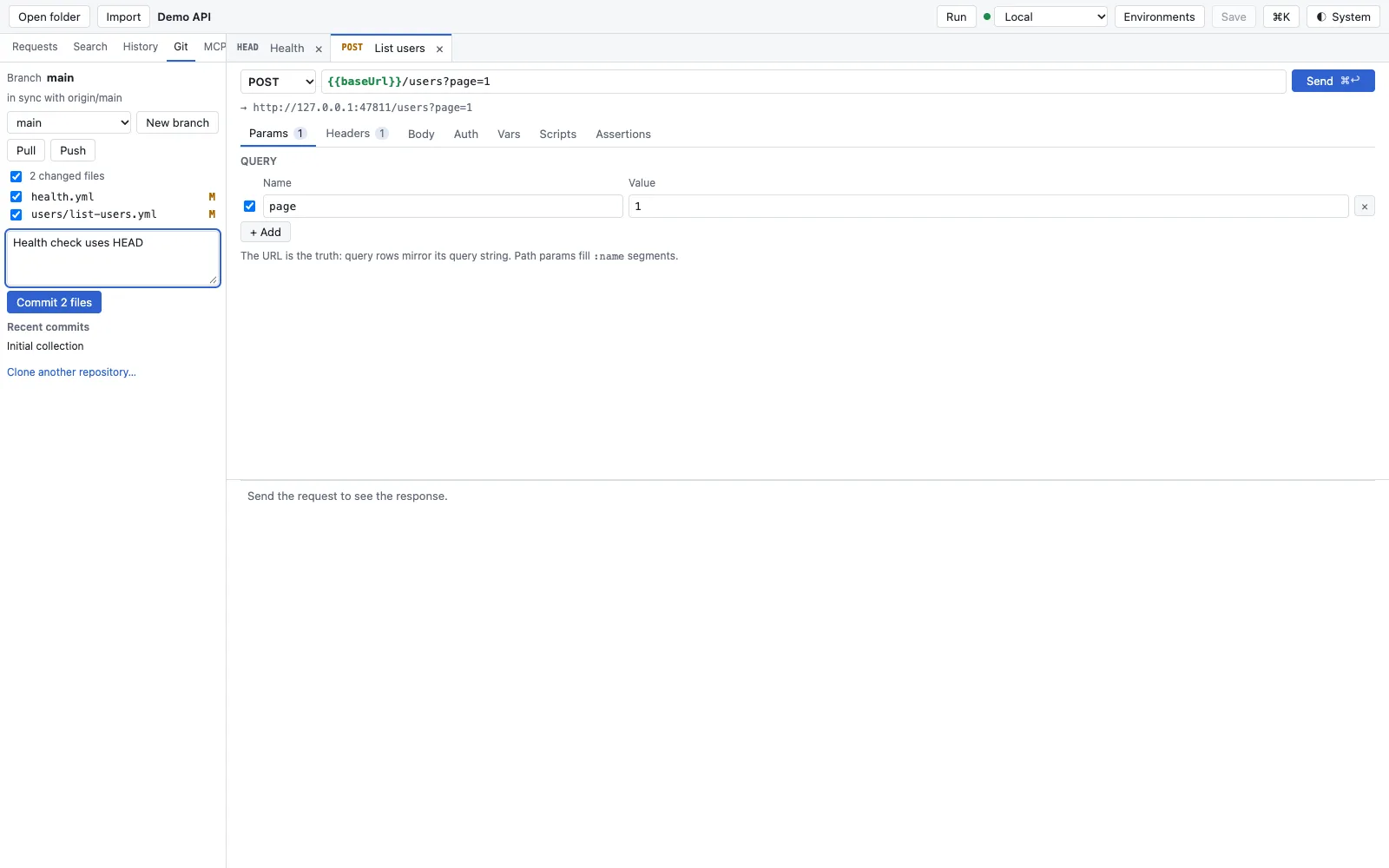
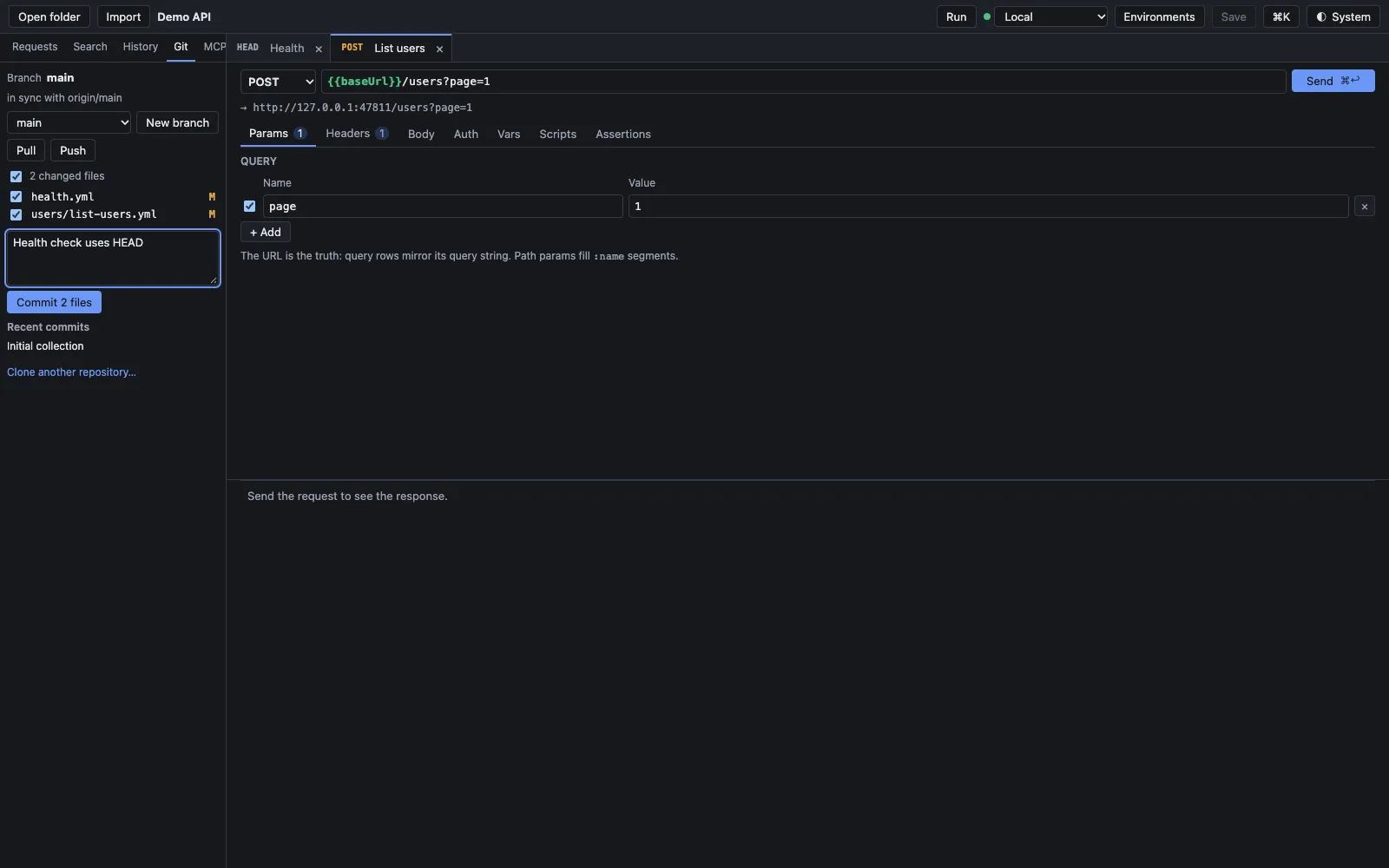
OpenCollection format (YAML), one file per request, folders as folders. The app is only a view of the folder.
Byte-identical read and write3
Unchanged parts stay byte-identical, tested on 86 Bruno collections. What a writer cannot do, it refuses.
Git without a staging area4
Commit with chosen files, branches, pull, push and resolving conflicts; refuses while there are unsaved changes.
Secret scanner before the commit5
A commit with credentials fails with file and line; exceptions only line by line with rt-scan:allow.
Import with a loss report6
Six sources, one report per import with the request where something is missing. Scripts stay unchanged.
Sync between your devices7
End-to-end encrypted. Planned; Git stays the way for collections in a team.
How does a request go out with the right values and the right token?
Send with one keystroke8
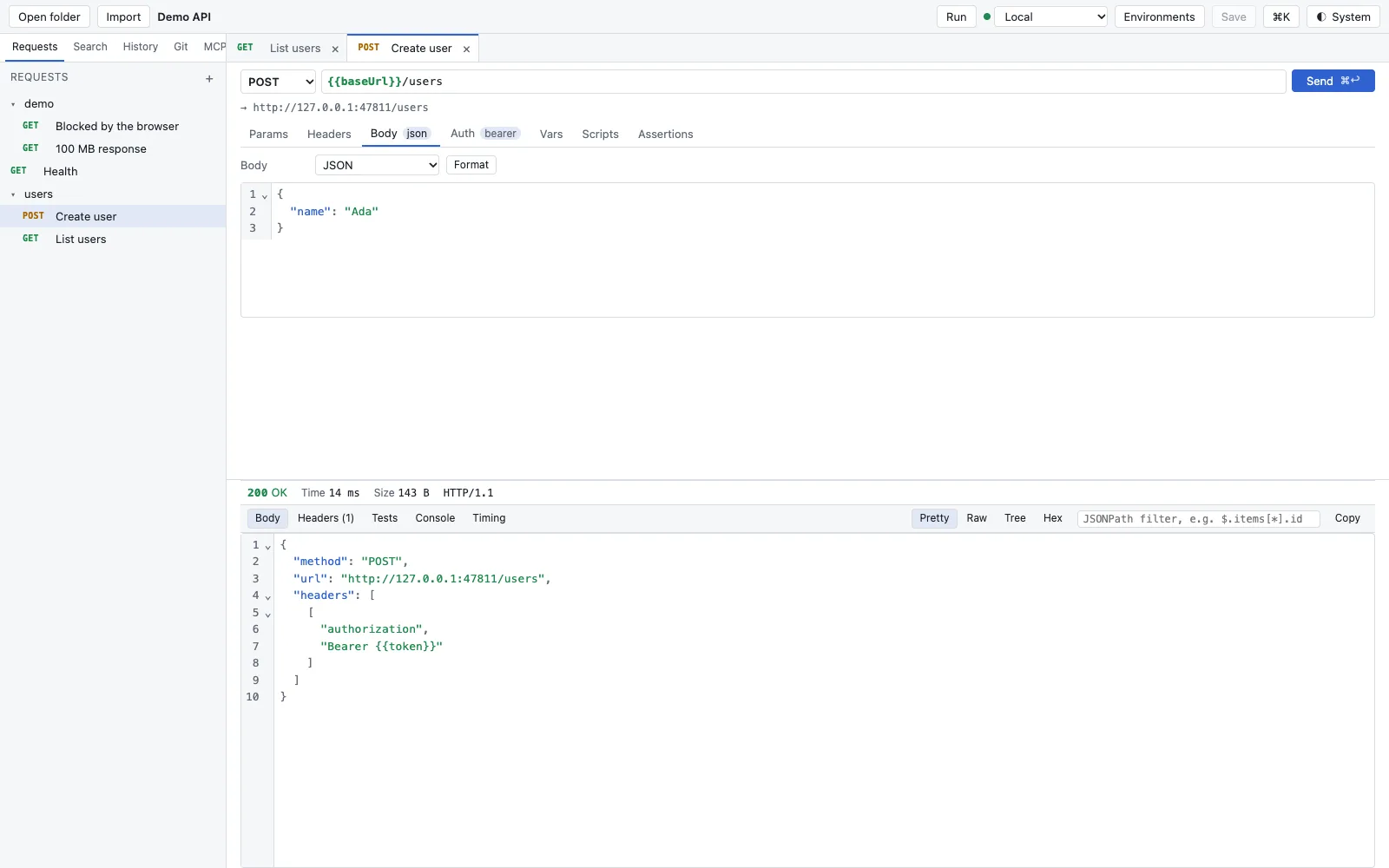
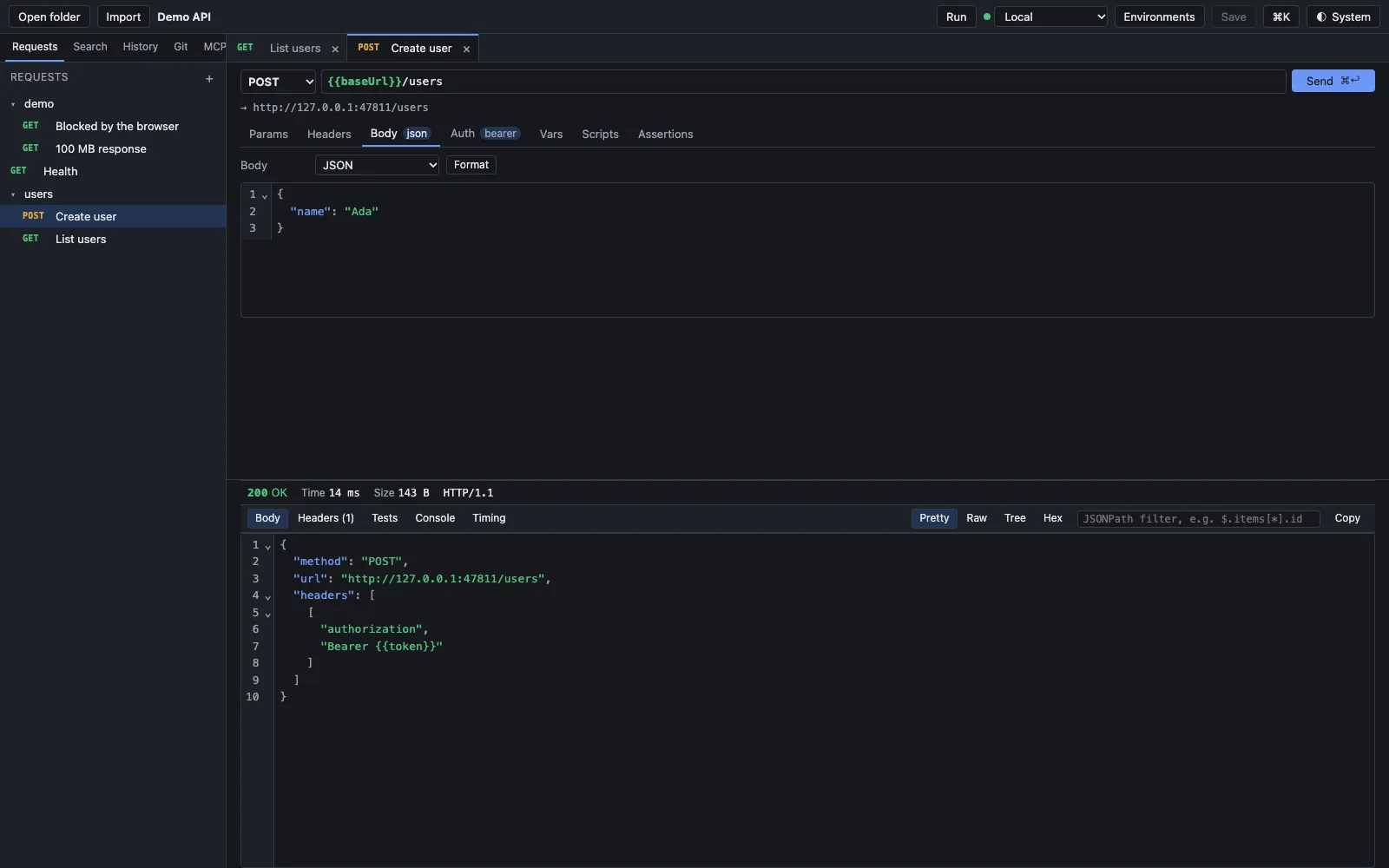
Cold start under 500 ms, under 150 MB when idle, sending in at most two keystrokes – measured as a release gate.
Large responses without stutter9
The response stays in the Rust core; the user interface only fetches the visible lines.
Variables with origin10
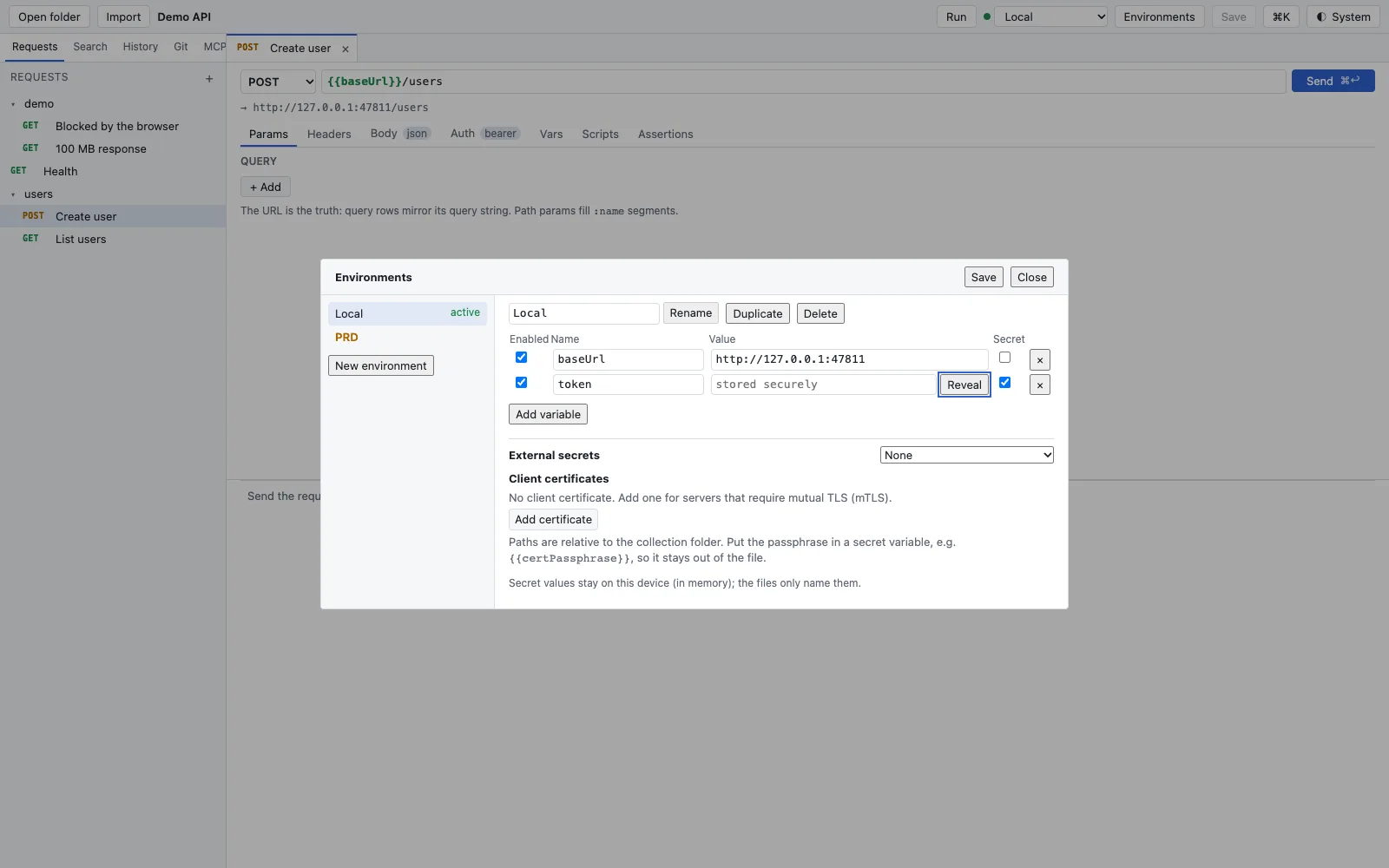
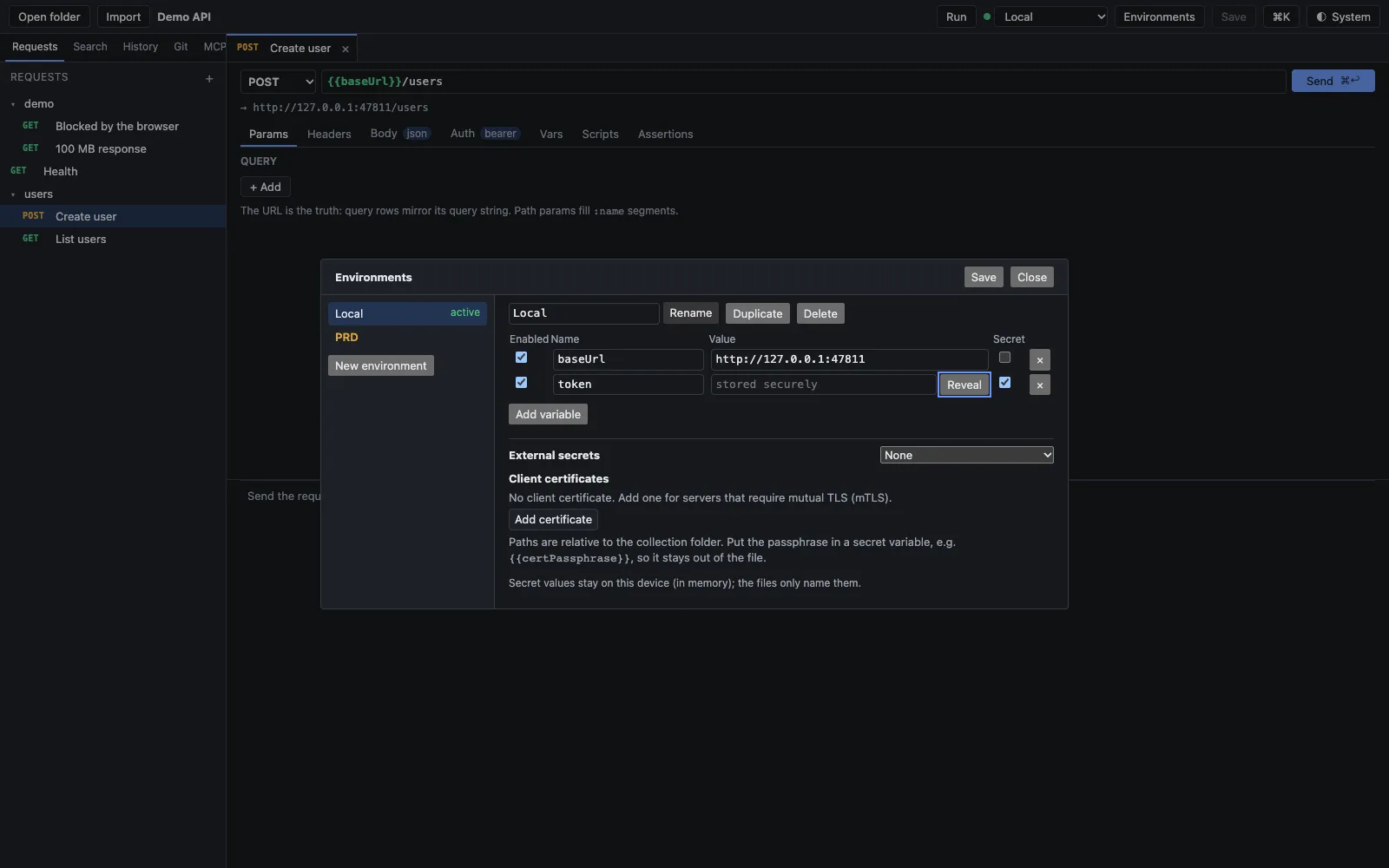
Six layers as in Bruno: global, collection, environment, folder, request, runtime.
Secrets in the keychain11
The operating system’s keychain, encrypted on the web; external from 1Password, Vault, AWS, Azure and Google.
OAuth 2.0, AWS SigV4, certificates12
Basic, bearer, API key; OAuth 2.0 with client credentials, password, authorization code with PKCE, device code, SAML 2.0 bearer.
Shared vault for the team7
Planned. Until then: the keychain per device or an external vault such as 1Password or Vault.
Is what is green in the app also green in the pipeline?
Scripts in a sandbox13
QuickJS as WebAssembly, the same engine in app, browser and CLI. No file or network access except through the request API.
pm.* and bru.* keep working14
Shims for bru, req, res, pm, postman and insomnia with a public coverage table.
Assertions without JavaScript15
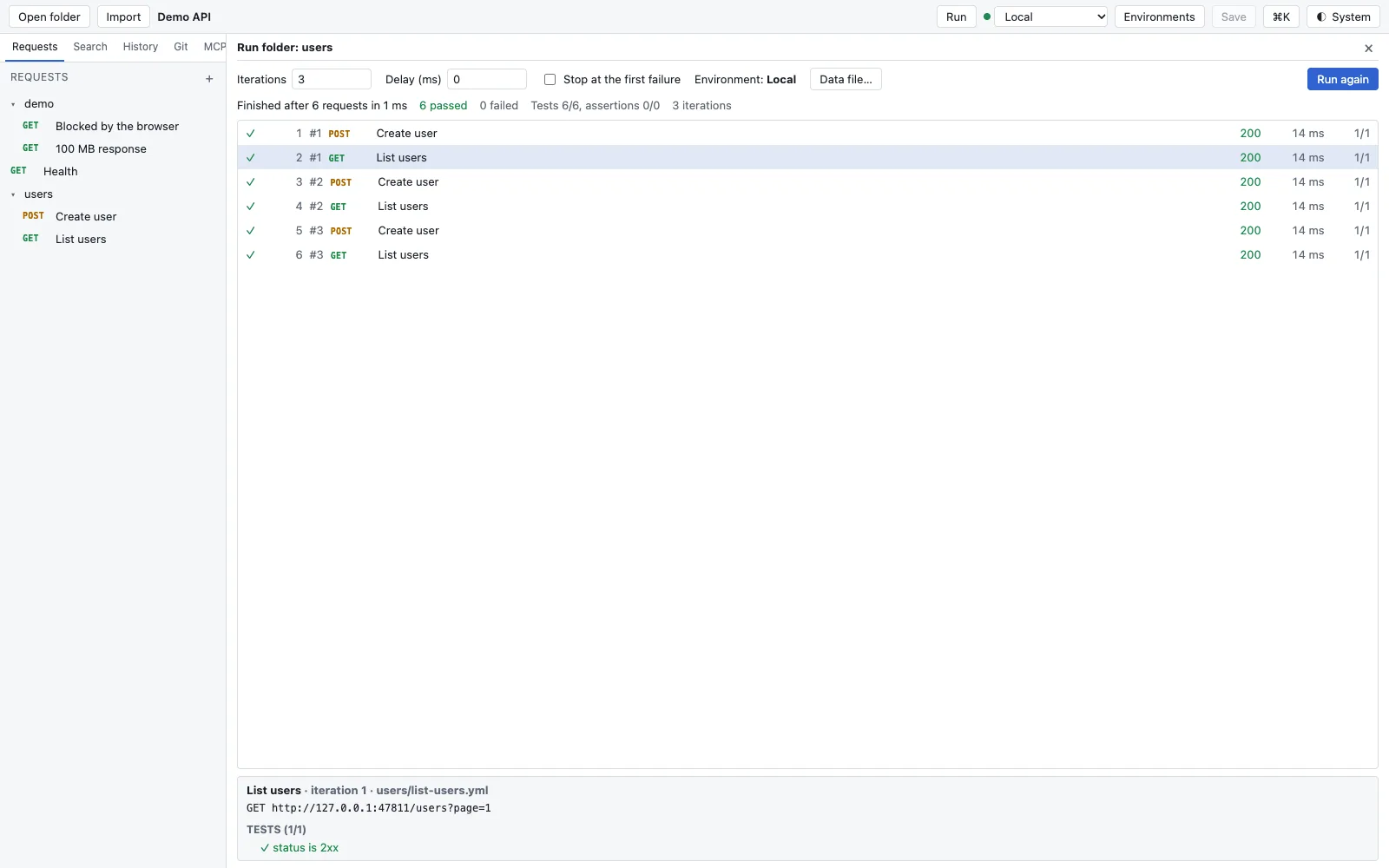
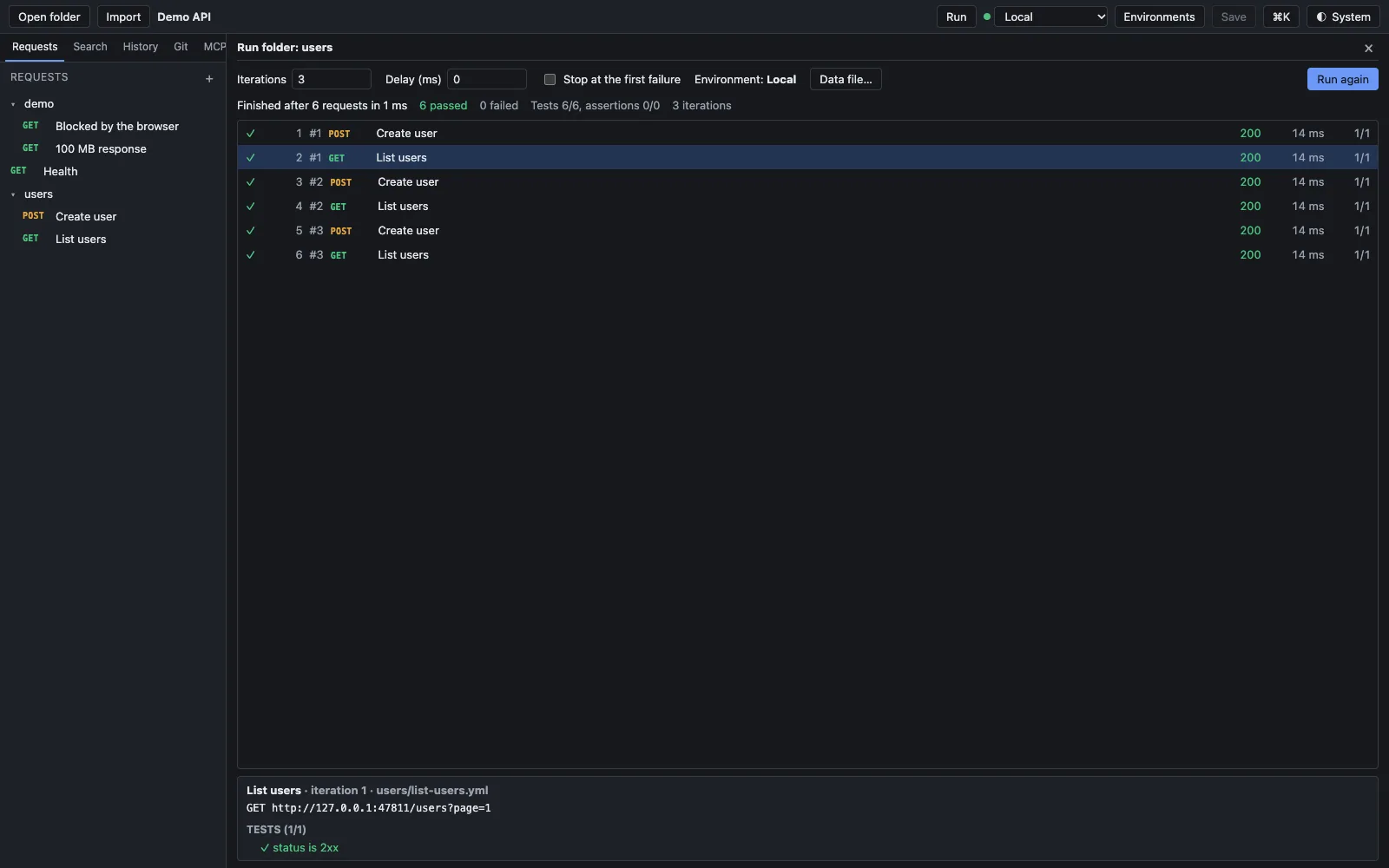
Assertions and variable actions right in the request; result in the report and in the pipeline.
Runner and rt run15
JUnit and JSON reports, exit code 4 for failed tests, GitHub Action and Docker image.
rt mock and rt docs16
Mock server from saved examples; static HTML documentation without scripts and without secret values.
THE SAME.
What is green in the app is green in the pipeline – because it is the same core1. A conformance suite sends the same cases through the native core and through the WebAssembly build in the browser and compares the results.
To the sourceAnd if the API speaks more than REST?
gRPC17
Unary and streaming, from .proto files or via server reflection; metadata as headers.
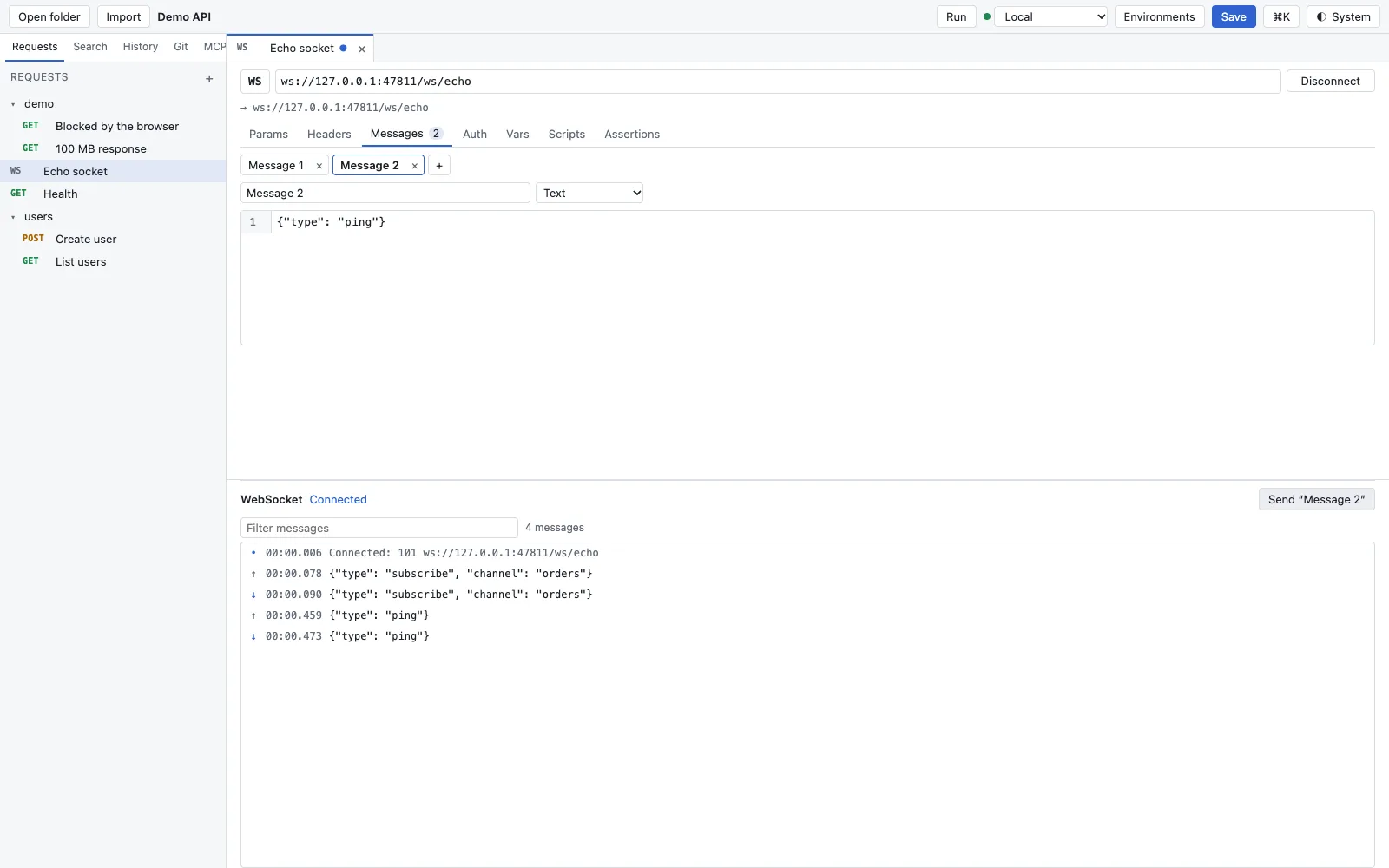
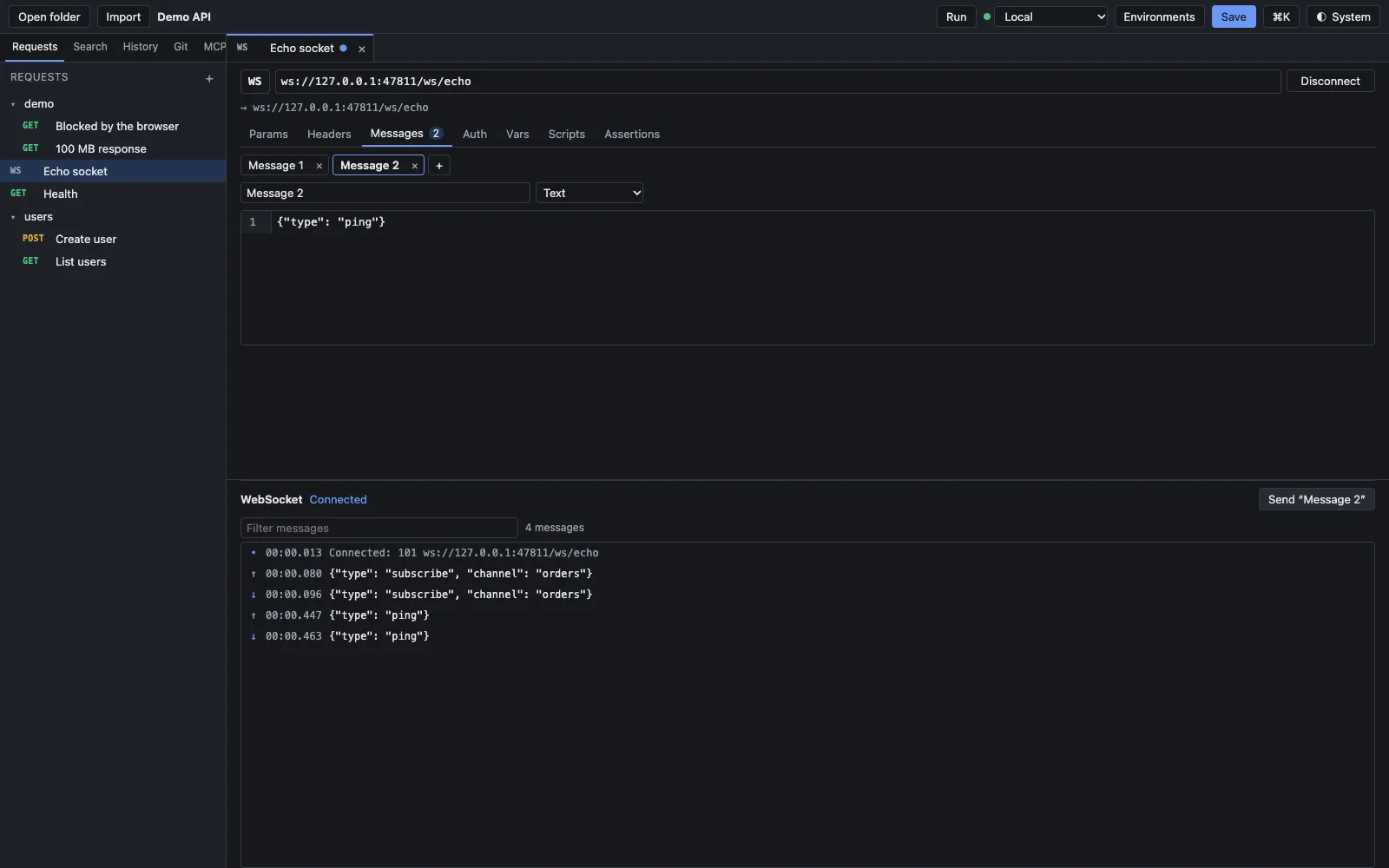
WebSocket17
Session log with masked secret values; in the web app through the companion.
Server-sent events17
A normal HTTP request; the view switches by itself for text/event-stream.
GraphQL17
A body with query and variables, sent as JSON; variables and auth as with every request.
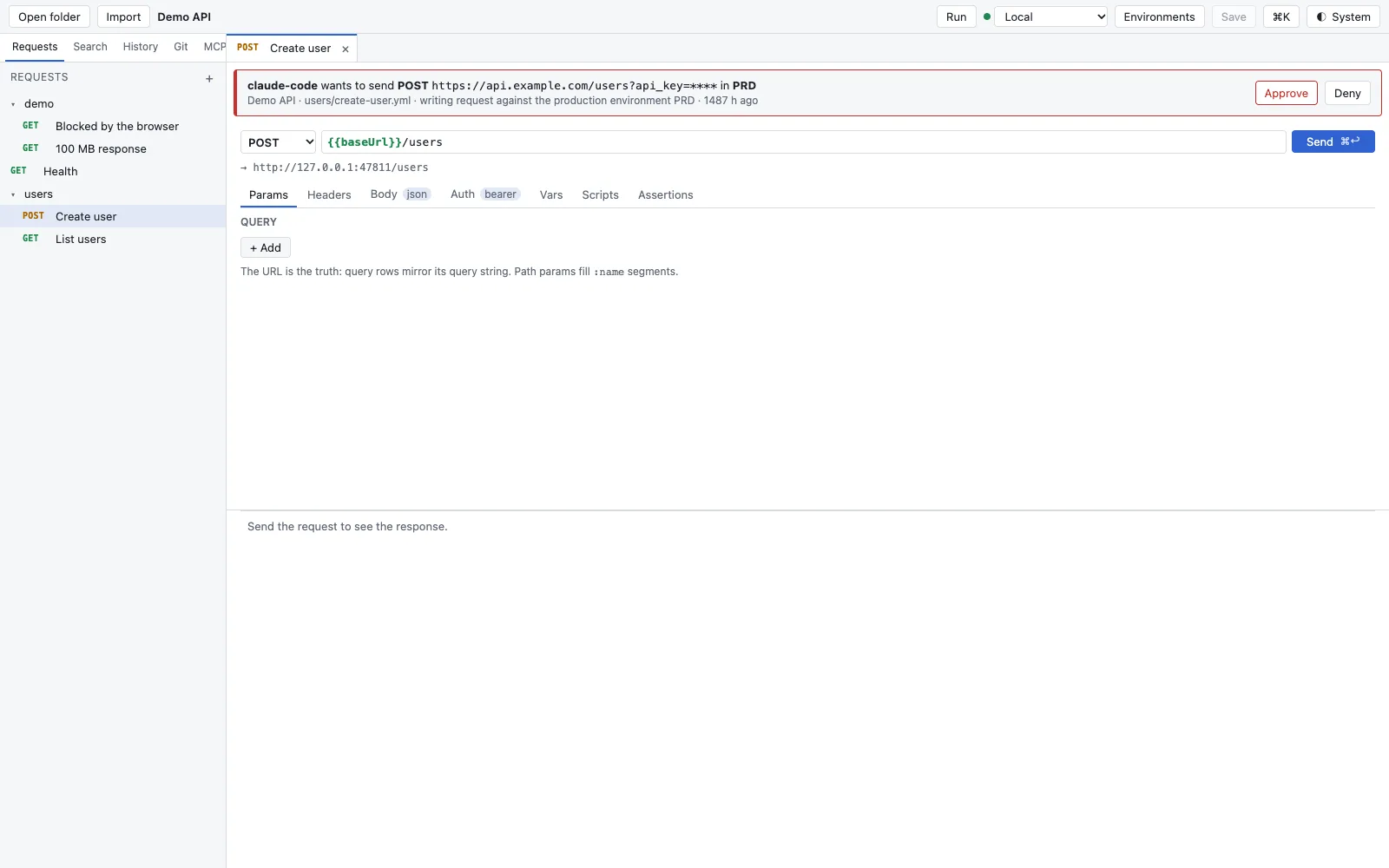
May an AI agent call your APIs – and who keeps watch?
MCP server rt mcp18
Five tools over stdio; a rule per environment (nothing, read, write), read-only by default.
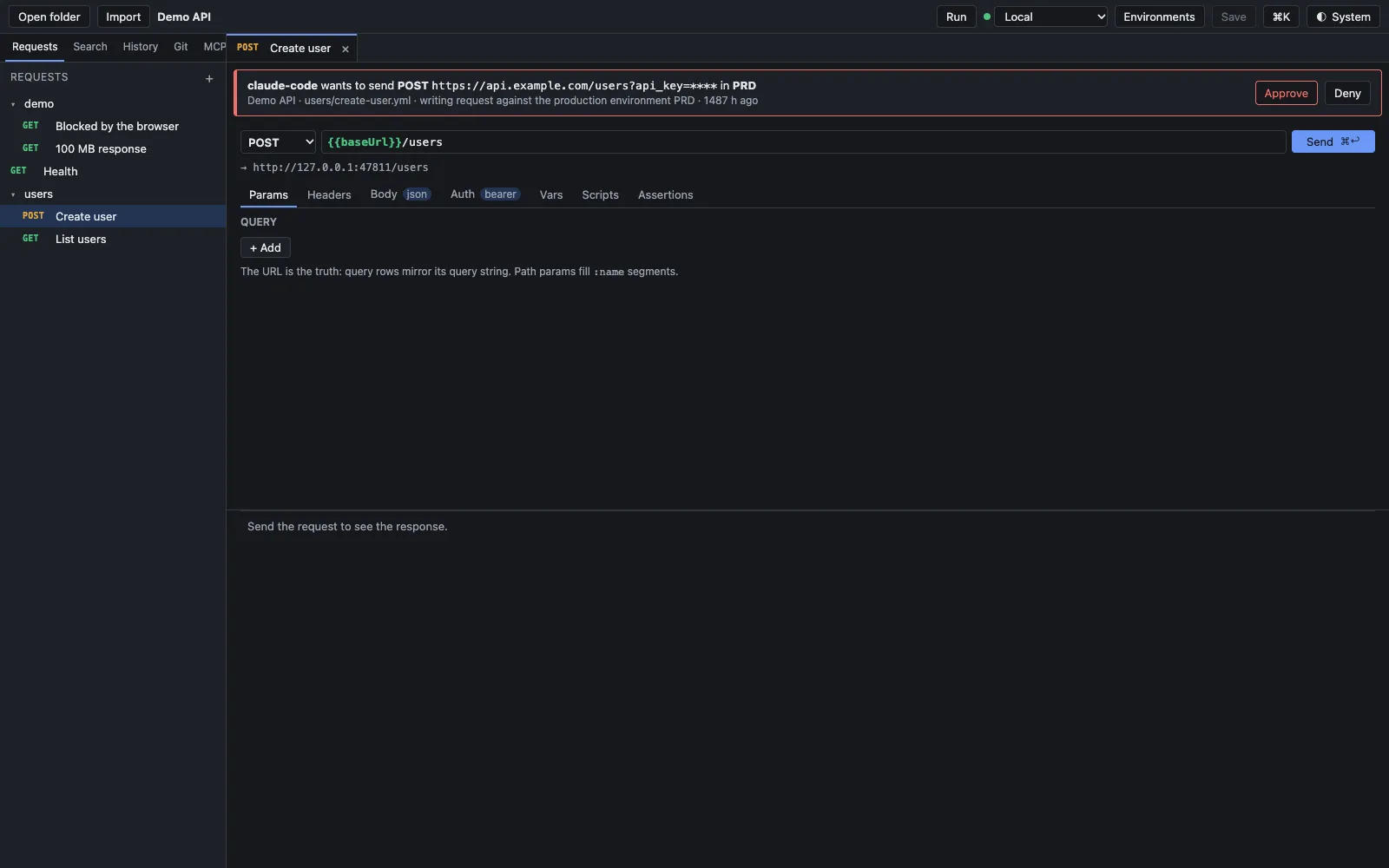
Approval for writes to production18
Approve in the app’s banner or with rt approve and rt deny; agents never see secret values.
MCP client with tests19
stdio and Streamable HTTP; tests as *.mcp.yaml next to the collection, rt mcp-test.
AI assistant with your own key20
Off until set up; Anthropic or OpenAI-compatible. Secret values are removed before sending.
AI quota without your own key7
Planned. Your own key stays in Free.
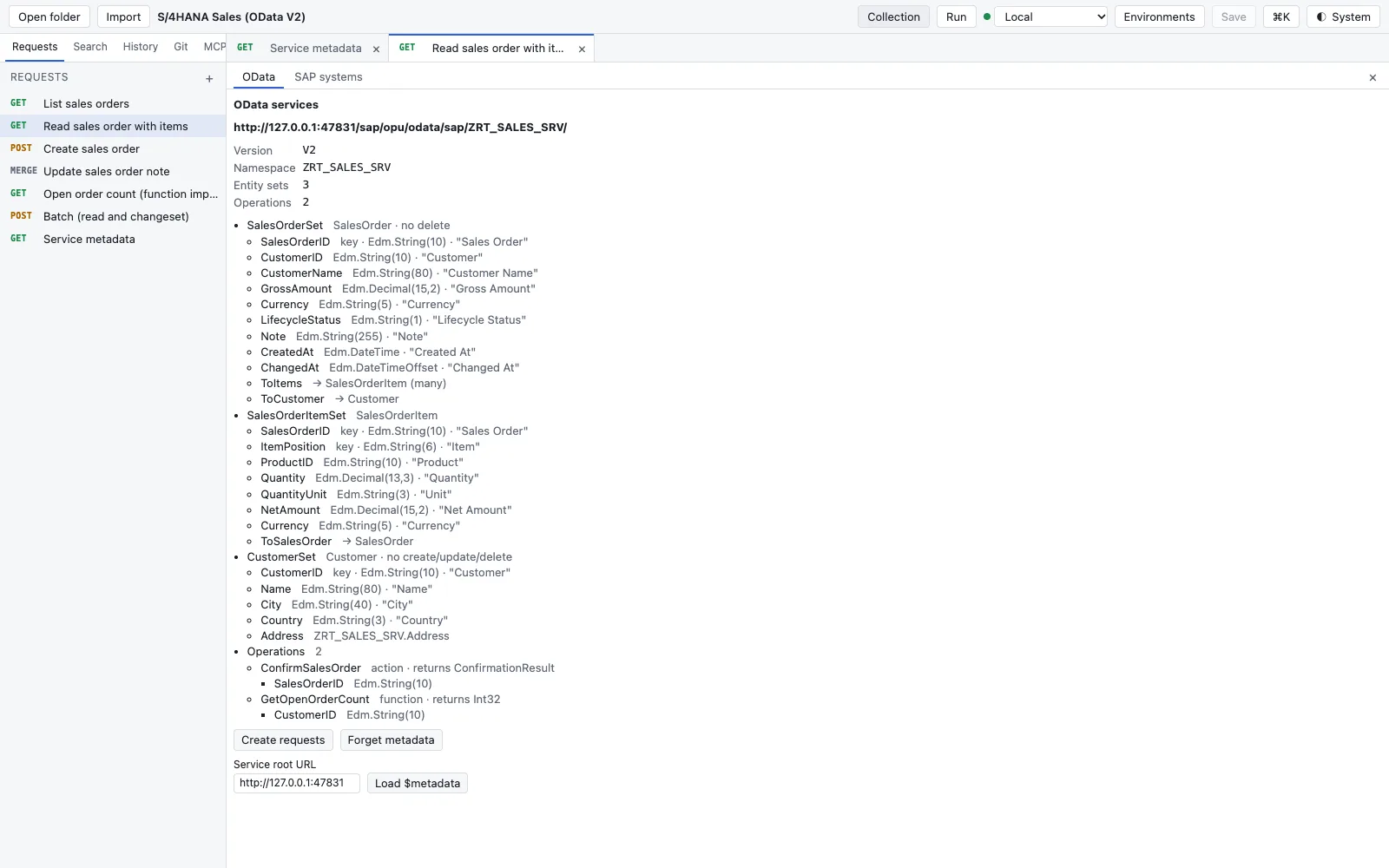
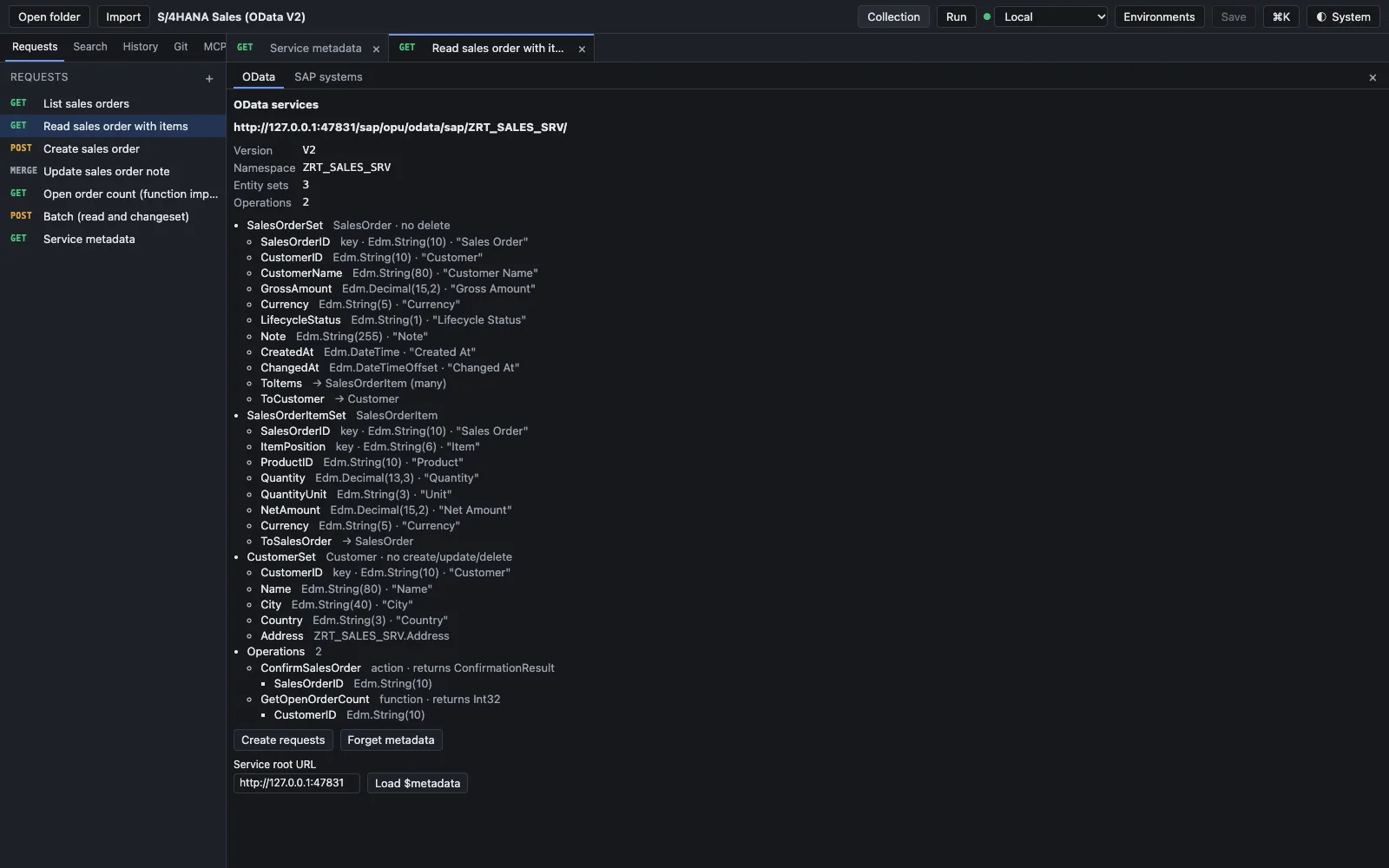
You test OData services from S/4HANA, CAP or RAP?
OData plugin: entities and query builder21
Entities, properties, navigations; $filter, $select, $expand, $orderby, $top, $skip and $count.
CSRF, ETag, $batch and drafts21
CSRF token automatically, If-Match from the ETag, $batch editor, draft flow for RAP and CAP.
DEV, QAS and PRD with sap-client21
Environments with sap-client; secrets without a value until you enter them.
Plugins as WebAssembly22
One .wasm file with a manifest; you see the permissions before installing. Public, versioned API.
BTP service keys and destinations7
Planned. The OData basics stay in Free.
Docs:
How does a whole team work together without giving away the files?
Sharing through Git7
Everything a team can do locally through Git is Free and stays Free.
Real-time workspaces7
Planned, with roles for reading and writing.
Roles7
Planned.
SSO and SCIM7
Planned.
Audit export and policies7
Planned. The local audit log of agent calls is already in Free.
Self-hosting and air gap7
Planned.
Free for everything that exists today.
The pills on every feature show from which edition it is included. The comparison puts everything in one table.
Purchase cancelled – nothing was charged.
Sources on this page
The superscript numbers in the text point here. Tap one to see the source right where it is used; all sources of this website are listed on one page.
- 1
One Rust core for desktop, web, CLI and MCP ↑Product · RequestTailor core repository, CLAUDE.md (Produktprinzip „Parität über alle Oberflächen“, Technische Leitplanken) · checked on 2026-11-22
- 2
Requests as OpenCollection YAML, one file per request ↑Product · RequestTailor core repository, CLAUDE.md (Produktprinzip „Dateien sind die Wahrheit“), crates/rt-format, website/docs/collections · checked on 2026-11-22
- 3
Byte-identical round trip, 86 Bruno collections ↑Product · RequestTailor core repository, testdata/collections/bruno, crates/rt-format (Round-Trip-Tests) · checked on 2026-11-22
- 4
Git in the app, without a staging area ↑Product · RequestTailor core repository, crates/rt-git (gitoxide), CLAUDE.md (App, Welle 4) · checked on 2026-11-22
- 5
Secret scanner before every commit ↑Product · RequestTailor core repository, crates/rt-app (secret_scan), crates/rt-cli/README.md (rt scan) · checked on 2026-11-22
- 6
Import from six sources with a loss report ↑Product · RequestTailor core repository, crates/rt-format/src/import, testdata/import/SOURCES.md · checked on 2026-11-22
- 7
Free, Pro, Team and Enterprise editions (concept) ↑Product · RequestTailor product concept (internal), section “Editions and prices” · checked on 2026-11-22
- 8
Performance budgets as release gates ↑Product · RequestTailor core repository, perf/budgets.toml, perf/README.md · checked on 2026-11-22
- 9
Large responses stay in the core ↑Product · RequestTailor core repository, CLAUDE.md (App, ResponseStore), perf/README.md · checked on 2026-11-22
- 10
Variables in six layers with origin ↑Product · RequestTailor core repository, crates/rt-core (vars::Scope), website/docs/environments · checked on 2026-11-22
- 11
Secrets in the keychain and from external vaults ↑Product · RequestTailor core repository, CLAUDE.md (Produktprinzip 3), crates/rt-cli/README.md (externe Secrets), website/docs/environments · checked on 2026-11-22
- 12
OAuth 2.0, AWS SigV4, client certificates ↑Product · RequestTailor core repository, crates/rt-core (model::auth), crates/rt-format/src/auth, testdata/sigv4 · checked on 2026-11-22
- 13
Script sandbox: QuickJS in WebAssembly ↑Product · RequestTailor core repository, crates/rt-script (api.d.ts, README) · checked on 2026-11-22
- 14
Shims for bru.*, pm.* and insomnia ↑Product · RequestTailor core repository, crates/rt-script/SHIM-COVERAGE.md · checked on 2026-11-22
- 15
Runner, rt run, JUnit and JSON, exit code 4 ↑Product · RequestTailor core repository, crates/rt-core (runner, assert), crates/rt-cli/README.md (Exit codes) · checked on 2026-11-22
- 16
rt mock and rt docs ↑Product · RequestTailor core repository, crates/rt-cli/src/mock.rs und docs.rs, launch/wave8/RELEASE-NOTES.md · checked on 2026-11-22
- 17
gRPC, WebSocket, SSE and GraphQL ↑Product · RequestTailor core repository, crates/rt-core (stream), crates/rt-grpc, launch/wave8/RELEASE-NOTES.md · checked on 2026-11-22
- 18
MCP server rt mcp with rules per environment ↑Product · RequestTailor core repository, crates/rt-cli/src/mcp, crates/rt-cli/README.md (MCP server), crates/rt-cli/tests/gate_w8.rs · checked on 2026-11-22
- 19
MCP client with saved tests ↑Product · RequestTailor core repository, crates/rt-app (mcp_client), crates/rt-cli/src/mcp_test.rs · checked on 2026-11-22
- 20
AI assistant, off until configured ↑Product · RequestTailor core repository, crates/rt-app (ai), website/docs/privacy · checked on 2026-11-22
- 21
OData plugin for S/4HANA, CAP and RAP ↑Product · RequestTailor core repository, plugins/odata, website/sap, website/docs/odata · checked on 2026-11-22
- 22
Plugins only as WebAssembly, with permissions ↑Product · RequestTailor core repository, crates/rt-plugin/API.md, plugins/README.md · checked on 2026-11-22
Questions about the features.
- Does RequestTailor open Bruno collections?
- Yes. RequestTailor reads and writes OpenCollection 1.0, the YAML format Bruno writes. Collections in that format open unchanged; reading and saving without changes gives byte-identical files, comments and formatting included. This is checked on every commit against 86 Bruno collections.
- Do my Postman scripts keep working?
- Largely. Scripts run in a sandbox on the RequestTailor script API; pm.*, bru.*, req and res are shims on top of it. The core's coverage list says which calls are covered; whatever an import cannot carry over is named in its loss report.
- Which authentication is supported?
- Basic, bearer, API key, OAuth 2.0 with client credentials, password, authorization code with PKCE, device code and SAML 2.0 bearer, plus AWS Signature Version 4 and client certificates. OAuth tokens live in the keychain; the interface only sees information about the token, never its value. Client certificates work in the Mac app and with rt, not in the browser.
- Can I use RequestTailor in GitHub Actions or GitLab CI?
- Yes. rt run runs a collection or a folder, writes JUnit and JSON and exits with code 4 when a test or an assertion fails. rt comes as a static binary for macOS and Linux, as a Docker image and as a GitHub Action.
- What is the rt agent companion?
- The web app runs in the browser and follows its rules: no request to servers without CORS headers, no client certificates. rt agent is a service on your own machine that sends such requests for the web app. It listens on 127.0.0.1 only, checks Host and Origin, pairs through a single-use code and keeps its tokens in memory only.
- What is in the works?
- End-to-end encrypted sync, a managed AI quota and SAP comfort such as BTP service keys and destinations (Pro), real-time workspaces, roles and a shared vault (Team), and SSO, SCIM, audit export, policies and self-hosting (Enterprise). On this page they carry the “In the works” label.
Your question isn’t here? Talk to me: +43 664 1964199 office@clouddna.at Get in touch